

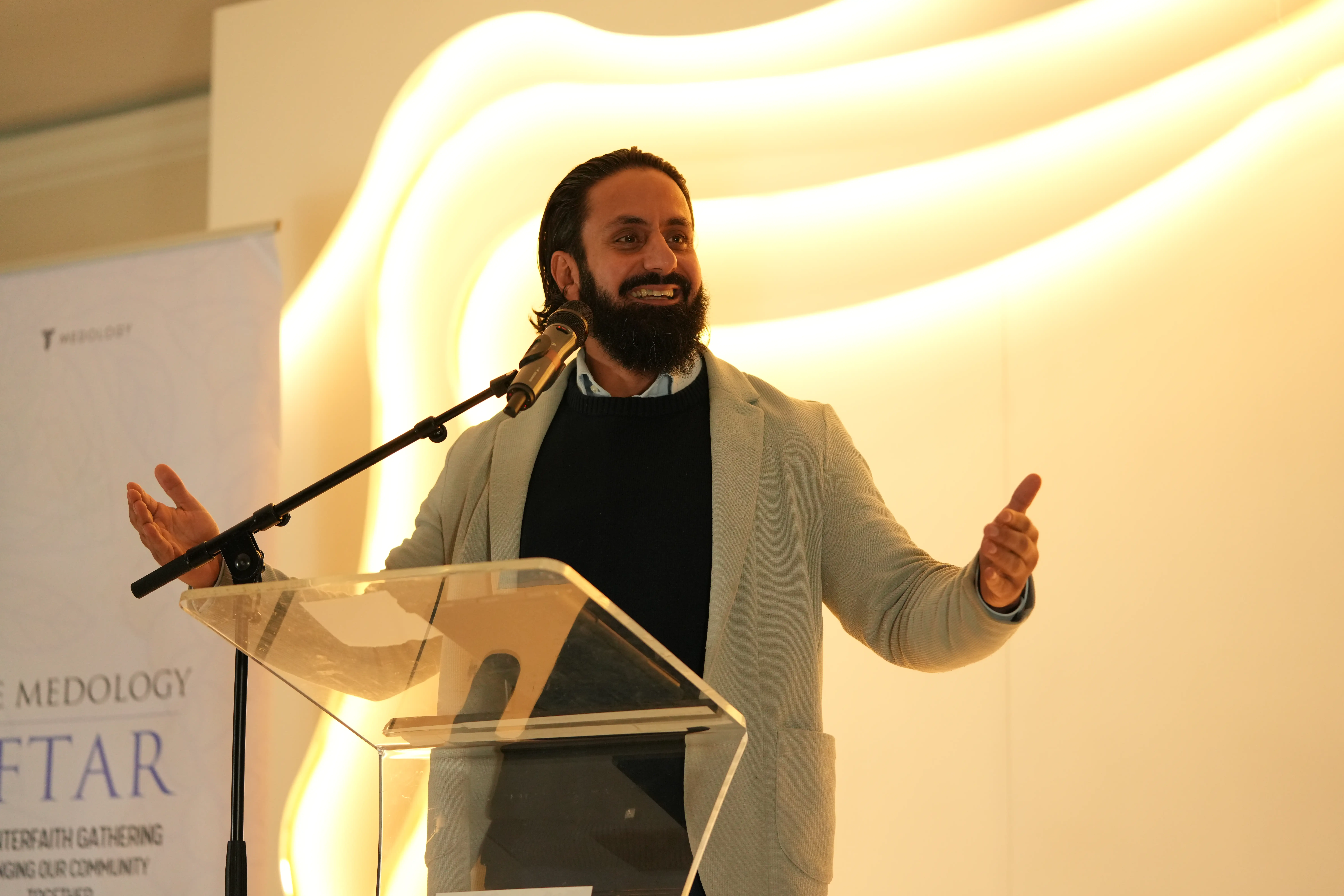
The real reason most communication falls flat
Ask most people what makes a great communicator and they will describe technique. Posture, pacing, eye contact, the mechanics of delivery. Dr. Andreas does not dismiss any of that, but he locates the real problem somewhere else entirely, and it is not a comfortable diagnosis.
In his telling, most communication fails because of what he calls undeclared negative intentions. Not dishonesty in the obvious sense, but the quiet, often unconscious agenda running beneath the surface of how we speak to people. The desire to look good. The fear of looking bad. The need to be right, to impose, to never be the one who concedes. These things leak. People pick them up. And no amount of technical polish covers for them.
He traces his own journey with this across two distinct phases. In his twenties, he was informed, articulate and increasingly confident in front of audiences. But underneath that there was a mixture of genuine intent and something else: the performance of competence, the protection of status. He describes the transformation that came in his early thirties not as a technical improvement but as something closer to liberation. What replaced the performance was simpler: a genuine commitment to the wellbeing of whoever he was speaking to. Not as a posture, but as the actual reason he was in the room.
When someone asked him how he speaks so passionately in front of large audiences, he said he tells them he is willing to fight every single one of them for what he is saying. The point is not aggression. The point is that when you are that committed to what you believe and to the people in front of you, you are freed of people's perceptions. The ego recedes. The self-consciousness dissolves. What remains is the communication itself.
His two principles are simple to state and genuinely difficult to live. Be committed to the wellbeing of your audience, not to how you come across to them. And be as egoless as possible, meaning not there to impose, not there to be right, not there to protect your reputation. If you speak from those two positions consistently, the technical development follows naturally. He has seen people move entire rooms in their third language, stumbling over words, because what came through was undeniably real. And he has watched polished, technically excellent speakers leave audiences unmoved because everyone in the room could sense, without being able to say precisely why, that the person at the front was performing.
Knowledge does not give you access to being
This is the line that lands hardest in the conversation, and it deserves to be taken seriously.
We live in an era of extraordinary access to information. The frameworks exist. The research is available. A brief search will hand you the principles behind better habits, stronger relationships, more consistent discipline, more empathetic leadership. And yet people do not change. Not at the rate the availability of information would suggest they should. The gap between knowing and becoming is, if anything, wider than it has ever been.
Dr. Andreas's diagnosis is precise. Abstract knowledge does not change your way of being. You can understand every principle behind a concept and still not live it. The knowledge stays outside you. It does not get in. This is, he argues, the central crisis of the online world: an endless production of content that informs without transforming, that describes without changing, that accumulates in people's minds whilst their actual way of being remains entirely untouched.
So what does bridge that gap? He identifies several things, noting that the full framework runs to around twelve elements, of which the conversation covers only a few.
The first is simply acknowledging that the gap exists. This sounds trivial. It is not. Most people operate as though knowing something and doing something are essentially the same thing, separated only by willpower. Treating them as genuinely different, as a structural gap requiring its own strategy to close, is the starting point for any serious change.
The second is vision. Not in the vague, motivational sense, but a specific, grounded image of who you are becoming. When you genuinely identify with a vision, when you see yourself as the person who lives this way, leads like this, operates from these values, your behaviour begins to reorganise around it. The language you use shifts. The decisions you make shift. The vision does not just show you a destination. It starts reshaping who you are in the present.
The third is the most counterintuitive: act before you feel ready. Emotion follows action, not the other way around. If you have identified with a vision, act in accordance with it even when the feeling is absent. Even when it feels effortful. Because repetition changes something. You do not just practise the action. You slowly become the person who does it naturally. Be. Do. Become. In that order.
Language is a fourth lever, and one people consistently underestimate. The way you frame yourself to yourself, the words you use about your own journey and your own failures, shapes who you are becoming. Harsh, reductive self-talk does not produce discipline. It produces stagnation. The way you narrate your own development matters, because language and identity are not separate things.
How to actually find your vision
Dr. Andreas is careful about who this question is even for. Not everyone is ready for a grand, long-term vision, and pressuring people to produce one before they have the intellectual, experiential or psychological foundation for it does more harm than good. For younger people especially, he advocates micro-visions: defined goals across specific domains, health, relationships, learning, craft, that build the internal architecture a larger vision eventually needs to sit on.
But when someone is ready for a larger question, his process is grounded and practical.
He starts with success. Not success as achievement, but success as a definition: what does it actually mean, to you, to have lived well? Without a clear answer to that, a vision is ambition dressed in nicer language. The vision has to be in service of something. It needs to know what it is for.
From there he turns to values. A real vision lives inside your value system. It cannot be borrowed wholesale from someone else's life. And within any value system there will be one or two things you feel most strongly about: the things that pull at you, that you keep returning to, that make you react in a way that pure information never does.
The way to find those things is disarmingly simple: ask the people who know you best. What do you always talk about? What do you consistently act on? What makes you genuinely react, not just politely engage? The pattern in their answers will be more accurate than anything you could arrive at alone, because you are, in a very real sense, more visible to other people than you are to yourself.
Once you have that, you apply what he calls the see, the be and the do. How do you see the world? Who do you need to be in order to bring that about? And what do you need to do, daily, weekly, monthly, across a lifetime, that necessarily links to who you need to be? Without that structure, vision remains aspirational. With it, it becomes operational.
What leadership actually is
Dr. Andreas has spent nearly a decade leading organisations, and his most strongly held view on leadership is also his simplest: it is not a status. It is not a title. It is not the authority to direct people. It is a way of being.
His framework, which he calls love service leadership, begins from a premise that most leadership culture quietly resists: the leader exists to serve those they lead, not the other way around. The good leader takes the blame and gives the credit. Their team's needs come before their own. And they earn influence not through position but through what he calls enrolment, the gradual, consistent demonstration of the values they want others to live by.
States of being give rise to states of being. This is the principle that underlies his entire approach to leadership. The culture of any team, family or organisation is a direct reflection of the actual, daily, lived way of being of whoever is leading it. If you want compassion in your organisation, you need to be compassionate. If you want forgiveness, you need to forgive first. If you want passion, you need to bring it before you ask for it. You cannot instruct people into a culture. You enrol them in one, through who you are in front of them every day.
He is equally direct about the failure mode: people who are drawn to leadership because they want to be known as a leader. The desire for authority as an end in itself is, in his view, precisely the thing that makes authority dangerous. If you chose power over principle, he says, power becomes your weakness. If you chose principle over power, principle becomes your success in the long run.
The challenge he leaves with Medology
Near the end of the conversation, Dr. Andreas is asked what challenge he would leave with Medology as an institution: what he would want to see from it across the next ten, twenty, fifty years.
His answer reframes the organisation's entire horizon. The world does not simply need more doctors and dentists. It needs human beings in an optimal state, psychologically, intellectually, physically, and in terms of their character. That is a far larger ambition than any single professional pipeline, and it is, in his view, exactly the ambition that the skills, sincerity and commitment he has observed inside Medology are capable of serving.
The challenge is not to keep doing what is already working. It is to stay sincere whilst thinking about what comes next. To remain principled as the scale grows. To build leaders from within the community who carry the vision forward beyond the founders. And to resist the temptation to define the institution too narrowly, when what it is actually building is something much harder and much more important than any credential: the conditions in which people can genuinely become who they are capable of being.
He ends, characteristically, with a thought about seeds. You do not need to deliver everything at once. You do not need to transform someone in a single conversation. If you plant something real in a person's heart or mind and they carry it with them, that is enough. The drop raises the ocean eventually. The work is to keep showing up, sincerely, for the long game.


.svg)
.svg)

.svg)